
Coral Garden, Puerto Galera: Snorkelling Without a Certification
Shallow coral heads on white sand in the sheltered water off San Antonio and Boquete — the site in Muelle Bay you can see properly with nothing but a mask.
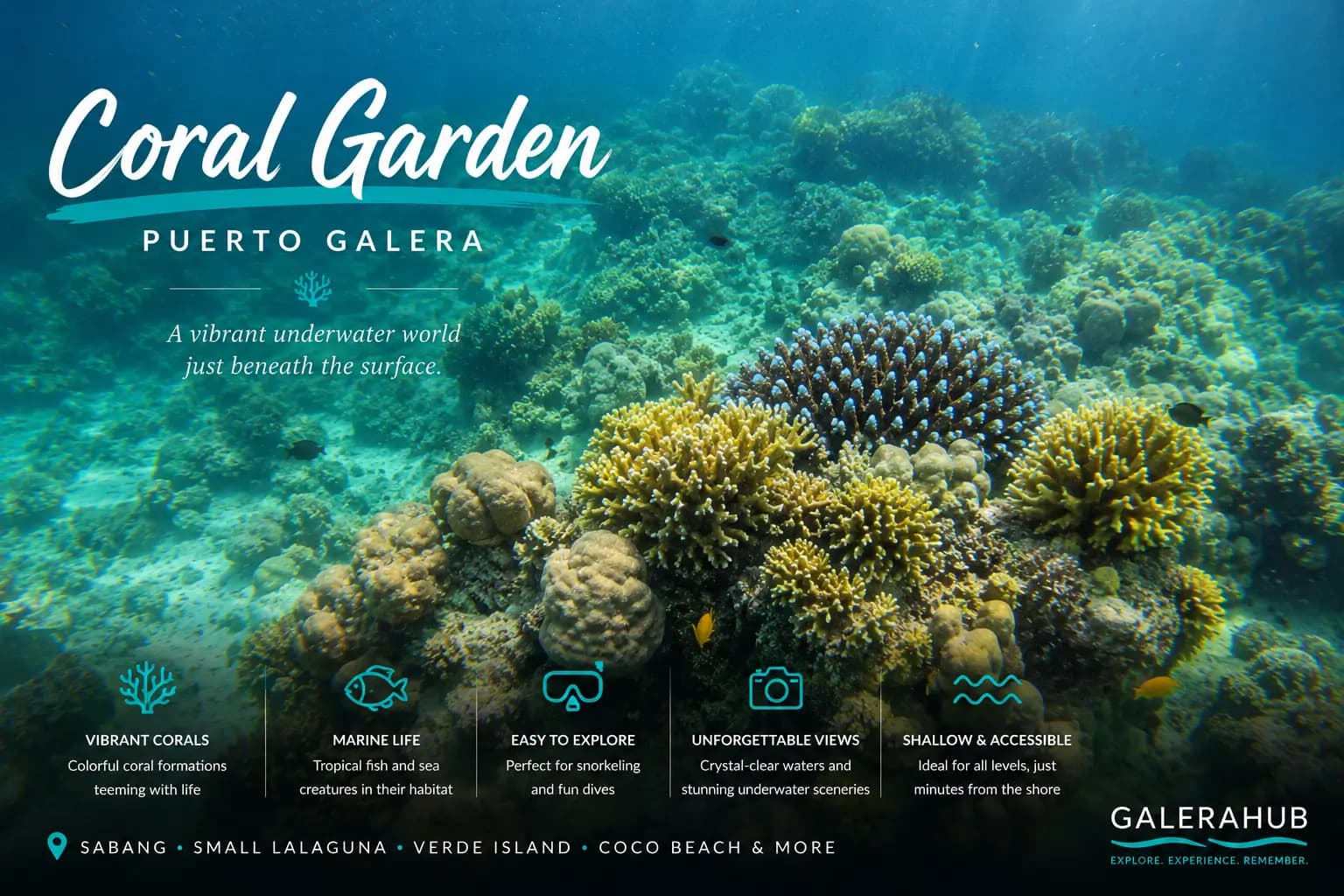
Coral Garden is the one everybody can do. Most of Puerto Galera's famous underwater sites need a tank, a certification and a boat that follows your bubbles. This one starts at the surface — coral heads scattered on white sand, shallow enough that a snorkeller floating on top sees the same thing a diver does.
It sits in the sheltered water off the small islands in Muelle Bay — San Antonio and Boquete — roughly ten minutes by boat from Sabang and only minutes from Muelle pier.
Why it works for snorkelling
Three things, and they have to be true together. The reef runs from close to the surface down to around 10 m, so there is something to look at without diving for it. The islands block the swell, so the surface is usually calm. And the bottom is pale sand, which throws light back up through the water — the reason photographs from here look bright even without a strobe.
Most of Puerto Galera's best underwater sites are a certification away. This one is a mask away.
The water you are floating in
Puerto Galera sits on the southern shore of the Verde Island Passage, the strait between Mindoro and Luzon. In a 2005 paper in Environmental Biology of Fishes, Kent Carpenter and Victor Springer identified the passage as the “center of the center of marine shorefish biodiversity” — the single richest patch of shallow-water fish life on the planet, at the heart of the Coral Triangle.
That is a claim about the strait as a whole, not about this particular reef, and it is worth keeping the two apart. But it is the reason a shallow, sheltered, easy site here holds what it holds: the water moving through the passage is carrying larvae from the richest shorefish assemblage on earth, and some of it settles in the calm behind these islands.
What is down there
The character of the site is hard coral: broad plate corals stacked like dinner plates, thickets of staghorn, and barrel sponges big enough to be landmarks. Around them, the usual permanent residents of a healthy shallow reef — clouds of anthias hanging above the coral heads, parrotfish grinding away at the rock, sergeant majors, damselfish, butterflyfish and angelfish working the gaps.
Give it ten minutes of hanging still and the reef stops hiding. The small things come out of the branching coral, the parrotfish stop moving away from you, and you start noticing the animals that were never going to swim past — a moray's head in a hole, a shrimp working a patch of sand, the cleaner wrasse running its station with a queue of customers.
Because it is shallow and bright, this is the site where people who have never snorkelled before understand what the fuss is about. It is also, for the same reasons, the one to bring a camera to.
Getting there
You do not swim to Coral Garden — it is a boat site, and every operator and hotel on the peninsula sells it. Two ways it usually appears:
- As a stop on an island-hopping tour. The standard route strings it together with the sandbar and the other islands in the bay. Cheapest per person, and you get thirty to forty minutes in the water.
- As a dedicated boat. Hire the boat rather than the seat and you decide how long you stay. Worth it if there are three or four of you, or if you are photographing.
Ask whether the price includes mask, snorkel and fins, and check the mask seals on your face before you get on the boat. A leaking mask is the single most common reason people cut a snorkel short.
When the water is clearest
Visibility here is mostly a question of what the weather did yesterday, not today. Through the amihan — the northeast monsoon, roughly November to February — conditions are typically settled and the water is at its clearest. Through the habagat, roughly June to October, rain puts run-off into the bay and the clarity drops for a day or two after a downpour before recovering.
Within a day, earlier is better: less boat traffic has stirred the sand, and the sun is high enough by mid-morning to light the reef without being so steep that everything glares.
Getting more out of an hour
- Breathe out slowly and stop swimming. Most people cover the whole site in fifteen minutes and see a third of it. The reef reacts to a floating shape that has stopped moving.
- Look under and behind things rather than across the top. The interesting animals are structural, not pelagic.
- Get the fins right. Loose fins are the reason beginners kick hard, and kicking hard is the reason beginners hit coral.
Not touching it
Shallow coral and snorkellers are a bad combination if nobody says anything, so: the coral here is close enough to the surface to stand on, and standing on it kills it. A plate coral that takes decades to grow breaks under one fin.
- Float, do not stand. If you need a rest, use the boat.
- Wear a rash guard rather than sunscreen where you can. You are face-down on a reef for an hour in equatorial sun; cloth is better for you and better for the coral.
- Keep fins up. Most damage is done by people who never saw what their feet were doing.
- Do not feed the fish. Bread brings a cloud of sergeant majors and teaches a reef to crowd boats instead of eating what it should.
Inside the reserve
These reefs are inside Puerto Galera's UNESCO Man and the Biosphere Reserve, designated in 1977. That is the reason a reef this shallow, this close to a busy bay, still has this much coral standing on it. What the designation covers is set out in A UNESCO Biosphere Reserve.
Where it fits
If you want the same water with a tank, see Diving Puerto Galera. If you would rather walk into the sea than take a boat, Big La Laguna has a house reef straight off the sand. The rest of the boat circuit is the sandbar to Paniquian and the Underwater Cave. Everything else on the peninsula is in Famous places & landmarks.
References & sources
- PADI — Coral Garden, dive-site directory (depth range and site description).
- Carpenter, K.E. & Springer, V.G. (2005), Environmental Biology of Fishes — “The center of the center of marine shore fish biodiversity: the Philippine Islands”.
- UNESCO — Puerto Galera, Man and the Biosphere Programme (MAB), designated 1977.
A note on the biodiversity claim: the “centre of the centre” finding describes the Verde Island Passage and the wider Philippine archipelago, not this reef specifically. We quote it for context — it is why the water here is what it is — rather than as a measurement of Coral Garden.
Founders of GaleraHub focused on trust-first local marketplace operations in Puerto Galera.
Have a story to share about Puerto Galera?
Tips, guides, seller spotlights — tell us what the community should know.
Pitch a story