
Diving Puerto Galera: The Canyons, Verde Island and the Passage
The Verde Island Passage was called “the center of the center of marine shorefish biodiversity” in 2005. Here is what that means with a tank on, and which sites are worth the boat ride.
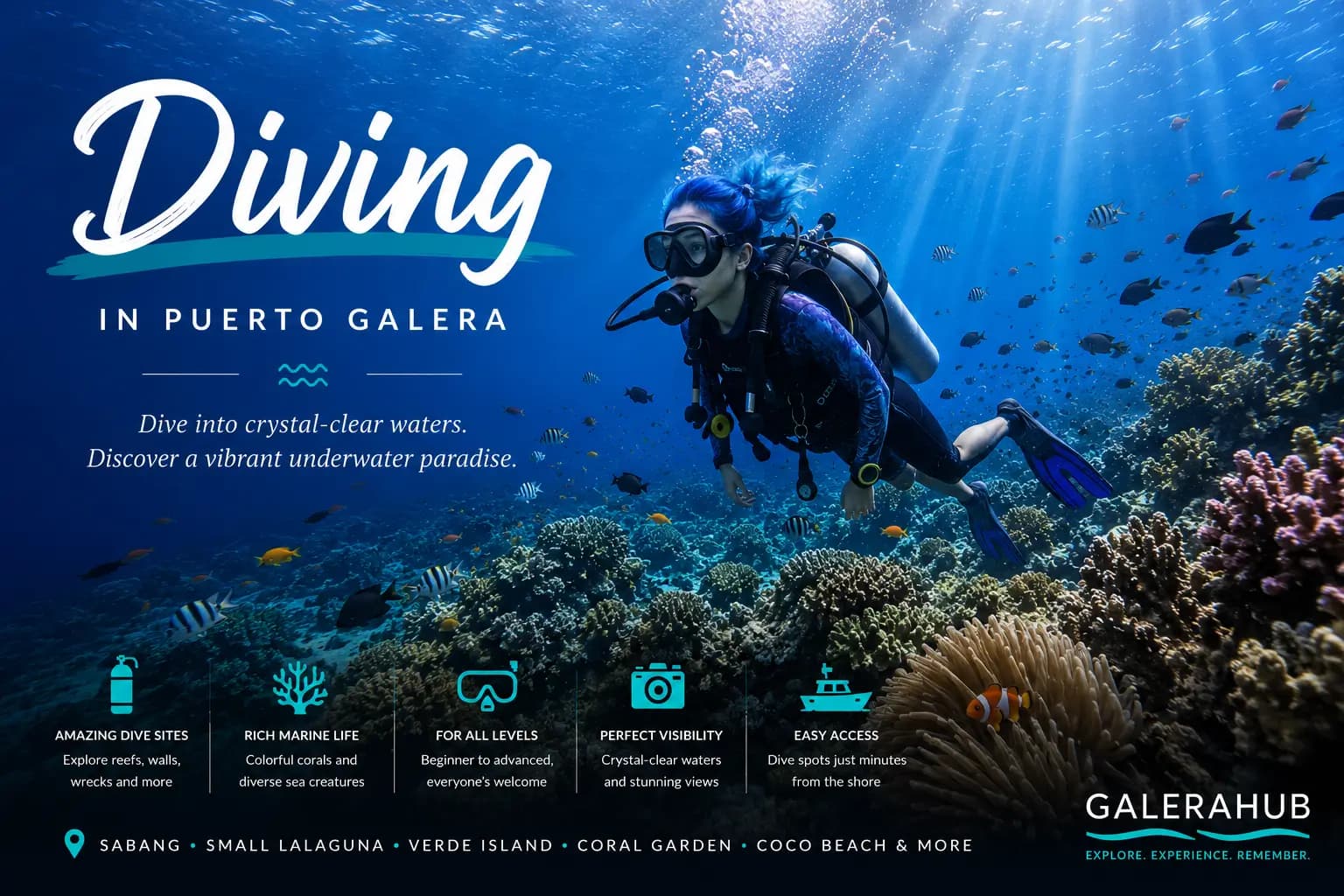
Puerto Galera is a diving town before it is anything else. The reason is not the reefs immediately in front of it — it is the stretch of water they sit in. The Verde Island Passage, the channel between Mindoro and Luzon, was described in a 2005 study by Carpenter and Springer as “the center of the center of marine shorefish biodiversity”.
That phrase gets repeated a great deal locally, usually without the paper attached. What it means in practice: of everywhere on earth where shorefish live, the highest concentration of different species converges here. You are not diving a good reef. You are diving the middle of the map.
What that looks like underwater
Mostly, it looks busy. The Passage funnels water between two land masses, and moving water means feeding — so the reefs here carry an unusual amount of life for their size, and a lot of it is small. Divers who come expecting big pelagics sometimes leave slightly puzzled; divers who like looking closely at a square metre of coral tend to extend their stay.
The Verde Island Passage does not have the biggest fish in the Philippines. It has the most kinds of them.
Come for the small things
This is macro country, and adjusting your expectations is most of the difference between a good week here and a disappointed one. The dives that people talk about afterwards are usually the ones where a guide stopped, pointed at what looked like a piece of rubble, and it turned out to be an animal.
Practically, that changes how you dive. A guide who finds things is worth more here than an extra metre of visibility, so ask the shop who is leading before you ask what the site is. Take the smallest camera you own rather than the widest lens. And slow down — a group covering ground sees the reef; a group hovering over four square metres sees what lives in it.
The sites people come for
These are the dives that fill the boats. Depths and conditions below are as the local operators describe them — currents here change with the tide, and your briefing on the day matters more than anything written on a page.
The Canyons
The signature dive, off the north-east side. Three consecutive coral canyons that you drift through rather than swim, typically in the region of 20–28 m, ending at an anchor wedged in the rock that most people photograph. It is a current dive — that is the entire character of it, and it is why it is usually run as a drift with the boat following your bubbles. Trevally and batfish hold in the flow.
Note the depth against your certification. The range operators quote sits below the 18 m limit an open-water course is taught to, so this is normally an advanced-level dive, run on a slack or a favourable tide rather than whenever a boat is free. If a shop offers it to you on your fourth ever dive, that tells you something about the shop.
Hole in the Wall
A short swim-through in the reef, small enough that you pass one diver at a time, and usually chained onto the Canyons on the same current. The transition through the gap and out into open water is the moment people remember.
Verde Island Drop-off
The trip out to Verde Island itself — a wall dive on the far side of the Passage, roughly 18–30 m against a face of large sea fans and soft coral. It is a longer boat ride and usually a full-day, two-tank trip. If you only do one thing that takes a whole day, most operators here will point you at this one.
Coral Garden
The shallow one, and the exception on this list: it starts at the surface, so it works for snorkellers as well as divers. We have written it up separately in Coral Garden.
Currents, and why the briefing is the dive
Water moving through a strait between two land masses is the reason the diving here is good and the reason the planning matters. Sites turn on and off with the tide: the same canyon that is an effortless drift on one exchange is hard work an hour later, and operators schedule around that rather than around convenience.
Which means two things for you. Take the briefing seriously — where the boat will be, which way the flow runs, what to do if you come off the wall. And accept a changed plan without arguing; a shop that moves you to a different site because the tide moved is a shop doing its job.
When to come
Diving here runs year-round, and the seasons trade one thing for another. Through the amihan — the northeast monsoon, roughly November to February — conditions are typically settled, the visibility is at its best and the water is at its coolest, which for most people means a 3 mm suit rather than a shorty. Through the habagat, roughly June to October, the water is warmer, run-off after rain can knock visibility down for a day or two, and boat days are occasionally lost to weather.
The shoulder months either side are the quiet compromise: fewer boats on the sites, prices softer, conditions usually fine.
Where the boats go from
Sabang is the dive base. The shops, the compressors, the boats and the instructors are concentrated there, and every site above is a short ride from that beach. If diving is the reason for your trip, stay in Sabang — being twenty minutes away by tricycle stops being charming at seven in the morning.
Big La Laguna, next door, has a house reef straight off the sand and a swimming area kept clear of boats, which makes it the usual choice for training dives and for anyone who wants to be in the water without booking a trip.
Learning here
Puerto Galera is one of the cheapest places in the Philippines to certify, and the reason is competition — there are a lot of shops in a small bay. That is good for price and it means the standard varies. Things worth asking before you hand over money:
- How many students per instructor. The number the agency allows and the number a good shop runs are not the same.
- Where your open-water dives happen — the house reef or the real sites.
- Whether the instructor teaching you is the one you meet. Shops rotate staff; ask early rather than on the morning.
- What the rental kit is like. Ask to see a regulator and a BCD before you book, not after.
Diving it without wearing it out
A reef this shallow and this busy is under constant, low-level pressure from the people who came to look at it. The fixes are the ordinary ones and they work:
- Sort your buoyancy before you sort your photographs. Nearly all contact damage is a diver who was concentrating on something else.
- Nothing hanging. Clip off gauges and octopus; a dangling console does more harm than a fin.
- Do not move animals to photograph them. A frogfish that has been prodded into a better position is a frogfish that leaves the site.
- Take nothing off the reef — including the empty shell that looks abandoned and usually is not.
The protection around it
The peninsula sits inside a UNESCO Man and the Biosphere Reserve, designated in 1977 — one of the earliest in the Philippines. That designation covers the reefs as well as the forest above them, and it is the reason there is still something here worth putting a tank on for. What it means in practice is set out in A UNESCO Biosphere Reserve.
Where it fits
Start at Sabang for the town the diving runs from, Coral Garden if you would rather snorkel than dive, Big La Laguna for a reef you can walk into, and Famous places & landmarks for everything else on the peninsula.
References & sources
- Carpenter, K.E. & Springer, V.G. (2005), Environmental Biology of Fishes — “The center of the center of marine shore fish biodiversity: the Philippine Islands”.
- UNESCO — Puerto Galera, Man and the Biosphere Programme (MAB), designated 1977.
- PADI — Coral Garden dive site directory entry.
A note on depths: the figures above are the ranges local operators quote for these sites. They are a guide to what to expect, not a dive plan — take the numbers from your briefing.
Founders of GaleraHub focused on trust-first local marketplace operations in Puerto Galera.
Have a story to share about Puerto Galera?
Tips, guides, seller spotlights — tell us what the community should know.
Pitch a story