
The Sandbar & Paniquian Island, Puerto Galera: Walk It Before the Tide
A strip of white sand runs from the mainland to Boquete Island — also called Paniquian — with Muelle Bay on one side and Balatero Cove on the other. At high tide it is gone.

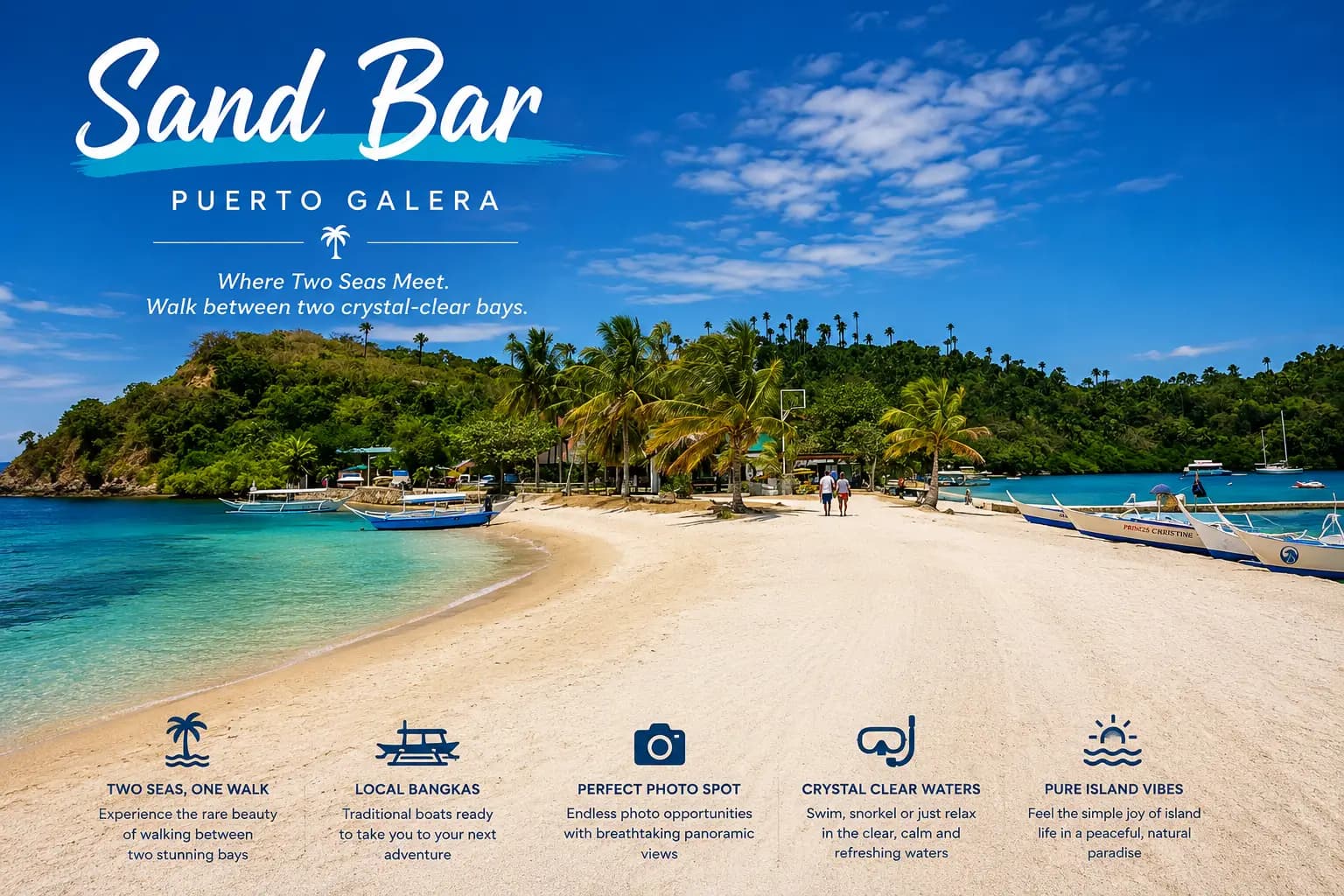
A narrow strip of white sand runs out from the mainland across Muelle Bay to Boquete Island — known just as often by its older name, Paniquian. At low water you can walk it. At high water you cannot, and the island is an island again.
That is the whole appeal, and it is why the sandbar turns up on every island-hopping itinerary sold on this coast. Standing on it at low tide you have Muelle Bay on one side and Balatero Cove on the other, close enough to see both at once.
The tide decides your visit
This is the one landmark in Puerto Galera where the time of day changes what exists. Come at low tide and there is a beach to walk along with water on both sides. Come at high tide and it is submerged — the boats still stop, but you are swimming off the island rather than walking to it.
It is the only place here where being three hours early is a completely different trip from being three hours late.
Ask your boat operator what the tide is doing before you book. They know, they check it daily, and it costs nothing to ask. If walking the strip is the reason you are going, this single question is the difference between getting it and not.
How to read the tide yourself
Philippine tides on this coast run to roughly two highs and two lows a day, and the whole cycle shifts later by about an hour with each day that passes. That last part is what catches people: the low tide that exposed the sandbar beautifully on Tuesday morning is a mid-morning affair by Thursday and gone by the weekend.
Two practical consequences. First, if you have a fixed day, check that day rather than trusting what a friend saw last week. Second, if you have a flexible week, pick the day — a sandbar is one of very few attractions where choosing the date buys you a different landmark.
The bigger swings matter too. Around a new or full moon the tidal range is at its widest, so the low is lower and the strip is at its most generous; between them the range narrows and even a low tide may leave the sand under a few centimetres of water.
The island itself
Boquete is small and quiet, with pocket beaches around its edge — Haligi is the one most trips stop at — and calm, clear water for swimming. There are no crowds in the White Beach sense and not much in the way of facilities, which is the trade people come for.
It is also the part of the trip that survives a bad tide. If the strip is under water, the island is still there, the beaches are still there, and the swimming is arguably better with more water over the sand — you just do not get the photograph of yourself standing in the middle of the sea.
Getting there
By boat, from Muelle pier or from Sabang. It is almost always sold as part of a circuit rather than on its own:
- Island-hopping tour. The standard route pairs the sandbar with Coral Garden, the Underwater Cave and the island beaches.
- Your own boat. Hire the whole boat and you can time the trip to the tide instead of to the operator's schedule — which on this particular stop is worth more than it sounds.
The economics are simple enough: a seat on a shared circuit is cheapest, and a private boat stops being extravagant somewhere around four people. On this stop, and only on this stop, the private boat also buys you the right time of day.
What to bring
- Cash, and not much of it. There is little to buy on the island. Bring water.
- Shade. A sandbar is the least shaded place in Puerto Galera by definition — there is no tree, no wall and no boat awning once you have walked away from it.
- Footwear you can swim in. Sand, then rock, then sand again.
- A rash guard rather than a bottle of sunscreen. You are on white sand in shallow water with the sun coming at you twice, direct and reflected.
A bay worth the protection
Muelle Bay is a member of the Most Beautiful Bays in the World club, and the whole peninsula sits inside a UNESCO Man and the Biosphere Reserve designated in 1977. The sandbar is a good place to notice why both designations exist: it is a shape made by water, and it is still here.
It is also the most fragile-looking thing on the circuit, and the least. A sandbar is rebuilt by every tide — what it will not survive is what gets left on it. Whatever comes off the boat goes back on the boat.
Where it fits
Start with Muelle Bay & Heritage Park for the bay this sits in, then the rest of the circuit — Coral Garden and the Underwater Cave. Everything else is in Famous places & landmarks.
References & sources
- UNESCO — Puerto Galera, Man and the Biosphere Programme (MAB), designated 1977.
- The Most Beautiful Bays in the World — member bays.
A note on sourcing: unlike the other landmarks on this coast, the provincial tourism office lists a resort on Boquete rather than the sandbar itself, so there is no official page for the feature. The tidal behaviour above is consistently reported by boat operators and visitors; the “50-metre” length quoted in some write-ups is not something we could verify, so we have left the number out. Tide times themselves are worth taking from a published table for Puerto Galera rather than from us.
Founders of GaleraHub focused on trust-first local marketplace operations in Puerto Galera.
Have a story to share about Puerto Galera?
Tips, guides, seller spotlights — tell us what the community should know.
Pitch a story