
Tamaraw Falls, Puerto Galera: The Waterfall Beside the Road
A tall ribbon of cold water falling straight onto the Calapan highway in Barangay Villaflor — the easiest waterfall to reach in Oriental Mindoro.

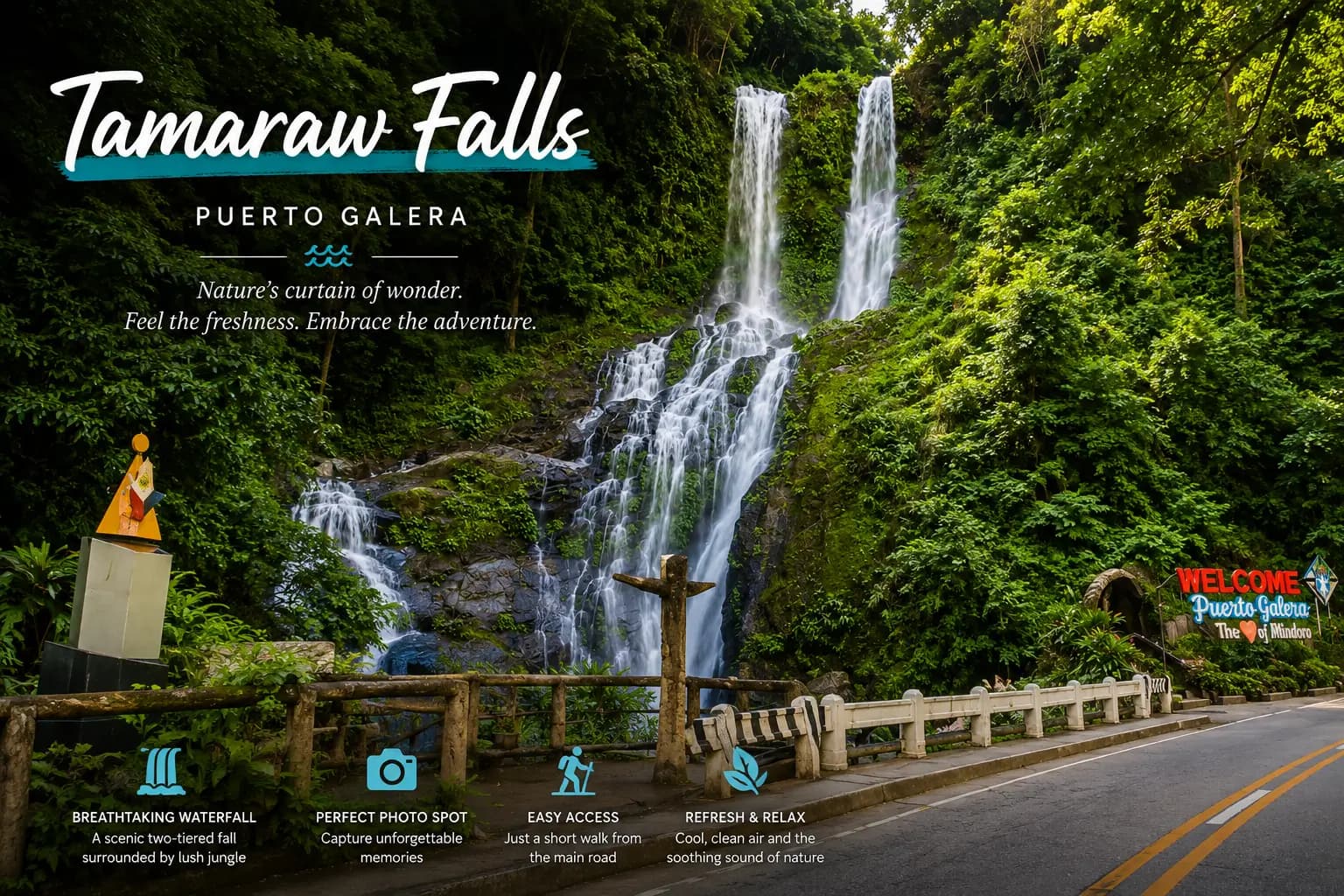
Tamaraw Falls is the waterfall you do not have to hike to. It comes down the mountain directly beside the Calapan highway in Barangay Villaflor, and you can be standing in front of it about a minute after you step out of the vehicle.
That is the whole reason it is the most-visited waterfall on this side of Mindoro. The provincial tourism office calls it “the most accessible waterfalls in Oriental Mindoro” and “a usual stopover for visitors going to other tourism sites in Puerto Galera” — which is exactly how most people meet it, as a stop rather than a destination.
The animal it is named after
The tamaraw is a dwarf buffalo found nowhere on earth except Mindoro. It is smaller than a carabao, stockier, with short horns that form a V rather than the carabao's sweep, and the IUCN lists it as Critically Endangered — the surviving animals live in the highlands in the middle of the island, a long way from this road.
You are not going to see one at the falls. But it is worth knowing whose name is on the sign: the province put its rarest animal on its most accessible landmark, and the mountains the water is coming off are the near edge of the country that animal still lives in.
What you actually see
Water falls in a tall, narrow ribbon down a dark rock face thick with moss and ferns, into a pool at road level. It is loud, it is cold, and it throws spray far enough that the railing is usually wet. The rock stays dark and wet year-round, so the green on it is permanent — this is not a face that dries out between rains.
You do not discover Tamaraw Falls. You come around a bend and it is simply there, beside the road, at full volume.
Stand for a minute before reaching for a camera. The thing photographs badly and sounds enormous, and most people leave with a picture that fails to explain why they stopped.
Wet season and dry season are two different waterfalls
The Philippines runs on two monsoons, and this waterfall answers to both. Through the habagat — the southwest monsoon, roughly June to October — the catchment above is soaked and the falls come down as a heavy white column that you can hear before you see. Through the amihan — the northeast monsoon, roughly November to February — the flow thins, the air is cooler and drier, and the drop narrows into strands.
By the end of the dry months it can be a modest thing. Both versions are worth stopping for, but they are not the same waterfall, and a photograph taken in August is not what you will find in April.
The other seasonal fact matters more: this is a mountain road in a country with a typhoon season. After heavy rain the river above rises fast, and the pool stops being somewhere to swim well before it stops looking like somewhere to swim.
The pools below
Downstream of the falls there are built swimming pools fed by the same river, with changing rooms and food stalls. They are run separately from the falls themselves and carry their own fee, so treat them as a different decision from stopping at the waterfall.
They are the reason some people stay two hours instead of fifteen minutes, and they are also why the site suits families in a way the falls alone would not — the pool water is contained, shallow at one end, and nowhere near the moving water at the base of the drop.
Getting there
Tamaraw Falls sits on the highway between Puerto Galera and Calapan, so it is on the way rather than off it. That road is the land link across the northern end of the island: it climbs out of the coastal strip, crosses the mountains and drops to the provincial capital on the far side. The falls are one of the things it passes.
Two normal ways to arrive:
- As a stop on a day tour. Most island and inland tours out of Sabang and White Beach pass it. This is how the majority of visitors see it, and it costs you nothing extra.
- On your own by tricycle or rented motorbike. It is a genuine mountain road with blind bends and trucks on it. If you have not ridden here before, this is not the road to learn on.
If you are travelling on to Calapan or coming from it, the falls are directly on that route — worth building fifteen minutes into the journey rather than making a separate trip.
Going in the water
The pool beneath the falls is deep, cold, and moving. People do swim in it, and people also stand under the fall itself, but the rock is slick and the current at the base is stronger than it looks from the roadside.
- Footwear with grip. The rocks around the pool are wet all day, every day.
- Watch the water level. After heavy rain upstream the flow rises quickly and the pool stops being a place to swim.
- Keep your phone dry. The spray reaches further than you think, especially in the wet season.
- Do not go in alone. Moving water, cold water and a slick bottom is the combination that catches confident swimmers.
How long to give it
Fifteen minutes if you are photographing it from the road. An hour or two if you are using the pools. It does not need a half day, and the people who enjoy it most are the ones who did not build their day around it.
Leaving it as you found it
The river that comes off this drop keeps going. It feeds barangays downstream and reaches the sea on a coast whose reefs are the reason most visitors are on this peninsula at all — what goes into the water here does not stay here. Carry your rubbish back out with you; the stalls will take it, and the bins at the roadside fill faster than they are emptied on a busy weekend.
Where it fits
Tamaraw Falls is the inland counterweight to a trip that is otherwise about water you swim in. Pair it with the Iraya-Mangyan Village and the Talipanan end of the coast for a day away from the beach, or treat it as the stop it is on the way to somewhere else. If you would rather walk to your waterfall than park beside it, Talipanan Falls is half an hour uphill through forest. The full picture is in our Famous places & landmarks guide.
References & sources
- Provincial Government of Oriental Mindoro — Tamaraw Falls, Travel Oriental Mindoro (location and the description quoted above).
- IUCN Red List — Bubalus mindorensis (tamaraw), Critically Endangered, endemic to Mindoro.
- UNESCO — Puerto Galera, Man and the Biosphere Programme (MAB), designated 1977.
A note on the height: you will see “423 feet” quoted widely online. The provincial tourism office does not publish a figure and the numbers in circulation disagree with one another, so we have described the falls rather than measured them.
Founders of GaleraHub focused on trust-first local marketplace operations in Puerto Galera.
Have a story to share about Puerto Galera?
Tips, guides, seller spotlights — tell us what the community should know.
Pitch a story