The Port of the Galleons: How Puerto Galera Got Its Name
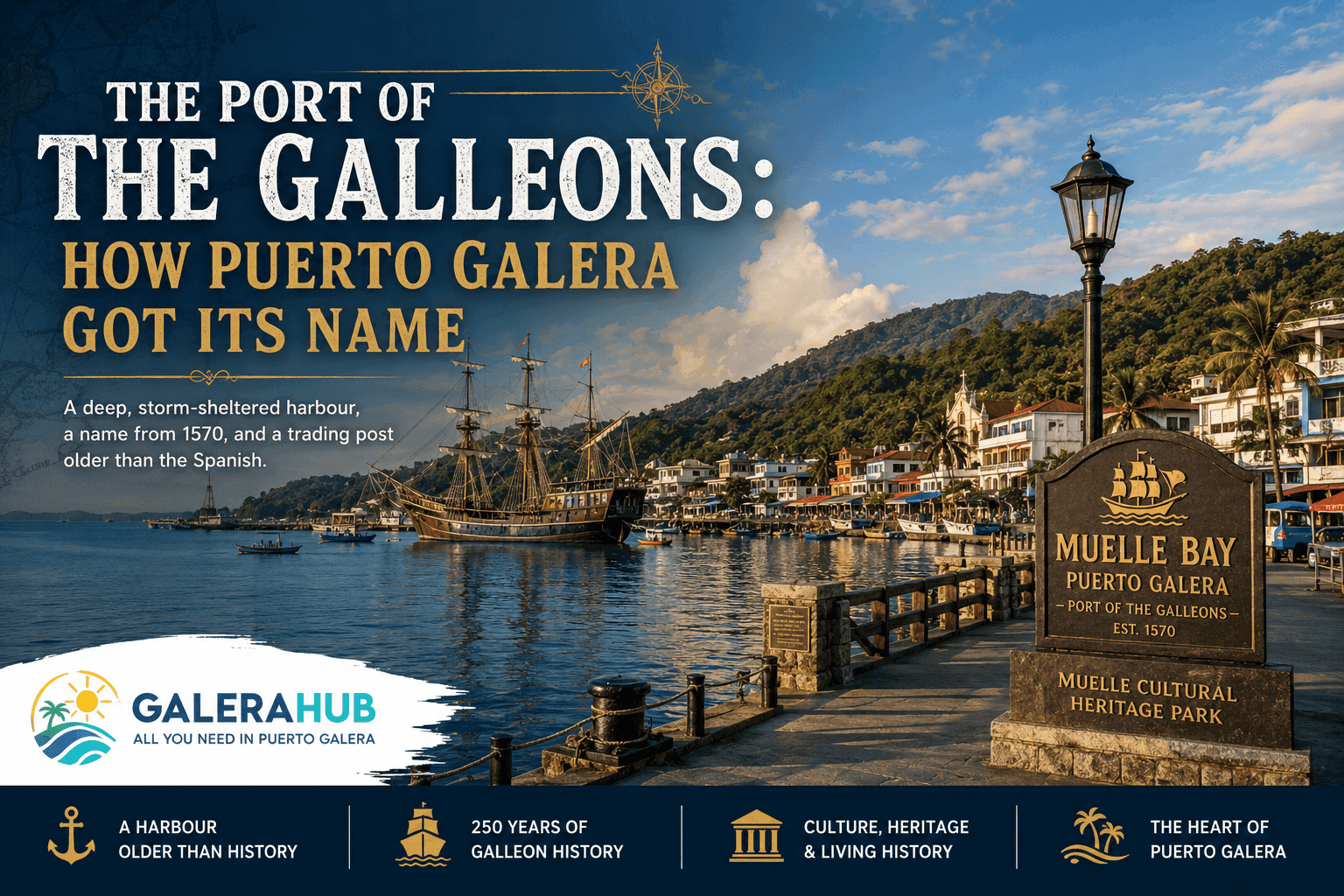
A deep, storm-sheltered harbour, a name from 1570, and a trading post older than the Spanish.
Say the name slowly and it tells you the whole story: Puerto Galera — the “Port of the Galleons.” Long before it was a beach destination, this deep, sheltered bay was a harbour, and it is that harbour, more than any single beach, that made the town what it is.
Here’s where the name comes from, why sailors have prized this bay for centuries, and where you can still stand in that history today.
What “Puerto Galera” means
“Puerto Galera” is Spanish for “Port of the Galleons.” The Spanish gave the town its name in 1570, and the reason was practical: the bay at Muelle is a deep, calm, storm-sheltered natural harbour — a rare safe place along this coast for a heavy galleon to ride out bad weather. When typhoons swept the passage, ships ran here to wait them out.
A harbour older than the name
The Spanish named it, but they did not discover it. Archaeologists have recovered quantities of Chinese trade ceramics— pieces linked to the Song, Yuan and Ming dynasties — from around Puerto Galera, evidence that the bay was an active trading post centuries before European ships arrived. Its sheltered waters made it a natural stop on the old maritime trade routes of the South China Sea.
The best natural harbour on a dangerous coast — that single geographic fact is why the town exists, why it was named for galleons, and why it still centres on its port today.
The galleon era
For 250 years, the Manila galleons linked the Philippines with Acapulco across the Pacific, and the seas around Mindoro and the Verde Island Passage were part of that world of sail. A deep, protected refuge like Muelle Bay mattered enormously in an age when a storm could sink a fortune in cargo. The town grew up around the harbour that kept ships — and their crews — safe.
Muelle Bay today
The same bay that sheltered galleons is still the beating heart of Puerto Galera. Muelle is the main pier and town centre — where many visitors first step ashore. Along the waterfront, the Muelle Cultural Heritage Park marks the town’s long story as a port, and the calm, sheltered water that impressed Spanish captains is now part of why Puerto Galera is the only Philippine bay in the international “Most Beautiful Bays of the World” club.
How to experience it
- Arrive by sea through Muelle and take a moment at the pier — you’re standing in the harbour the town is named for.
- Walk the Muelle Cultural Heritage Park on the waterfront.
- From Muelle Bay, join an island-hopping trip to the Coral Gardens, the Sandbar and Boquete (Paniquian) Island.
One chapter of a bigger story
The Port of the Galleons is where Puerto Galera’s history begins — but the town is also a UNESCO Biosphere Reserve on the richest stretch of ocean on Earth, ringed with beaches, reefs and waterfalls. Explore them all in our Famous places & landmarks guide.
References & sources
- “Manila galleon,” Encyclopædia Britannica.
- “The Manila Galleon Trade (1565–1815),” The Metropolitan Museum of Art.
- The World’s Most Beautiful Bays — Les Plus Belles Baies du Monde (official association).
Founders of GaleraHub focused on trust-first local marketplace operations in Puerto Galera.
Have a story to share about Puerto Galera?
Tips, guides, seller spotlights — tell us what the community should know.
Pitch a story